
You bought an electric vehicle and you’re ready to have a charger installed in the garage. You know where you want it, you’ve picked out the charger, and when you look at your electrical panel, you can even see an open space where another breaker could go.
Then your electrician starts asking questions.
How big is the house? Is the range gas or electric? What about the dryer? Do you have air conditioning? A hot tub? An electric water heater? Suddenly, a fairly simple EV charger installation seems to have turned into an inventory of everything electrical in your home.
There’s a reason for all those questions. Before adding a significant new electrical load, we may need to know how much demand your home is already placing on its electrical service and whether there’s enough capacity for what you want to add. That’s where an electrical load calculation comes in.
An Electrical Load Calculation Looks at the House, Not Just the Panel
One of the easiest assumptions to make is that the size of the main breaker tells us everything we need to know. If you have a 200-amp service, for example, it might seem like there should be plenty of power available. If there are also empty spaces in the panel, the answer can seem even more obvious.
But those are actually two different questions.
The empty spaces tell us whether there’s physically room for another breaker. An electrical load calculation helps us determine whether the service has enough electrical capacity for the additional load.
That’s why we need information about the rest of the house. A home with a gas furnace, gas range and gas water heater may place very different demands on a 200-amp service than a similar home with an electric range, electric dryer, electric water heater, air conditioning, hot tub and other large electrical equipment.
The panel may look almost identical. What’s happening beyond the panel can be completely different.
So, How Is an Electrical Load Calculation Figured?
Thankfully, homeowners don’t need to sit down with a calculator and figure this out themselves. Your electrician does that part.
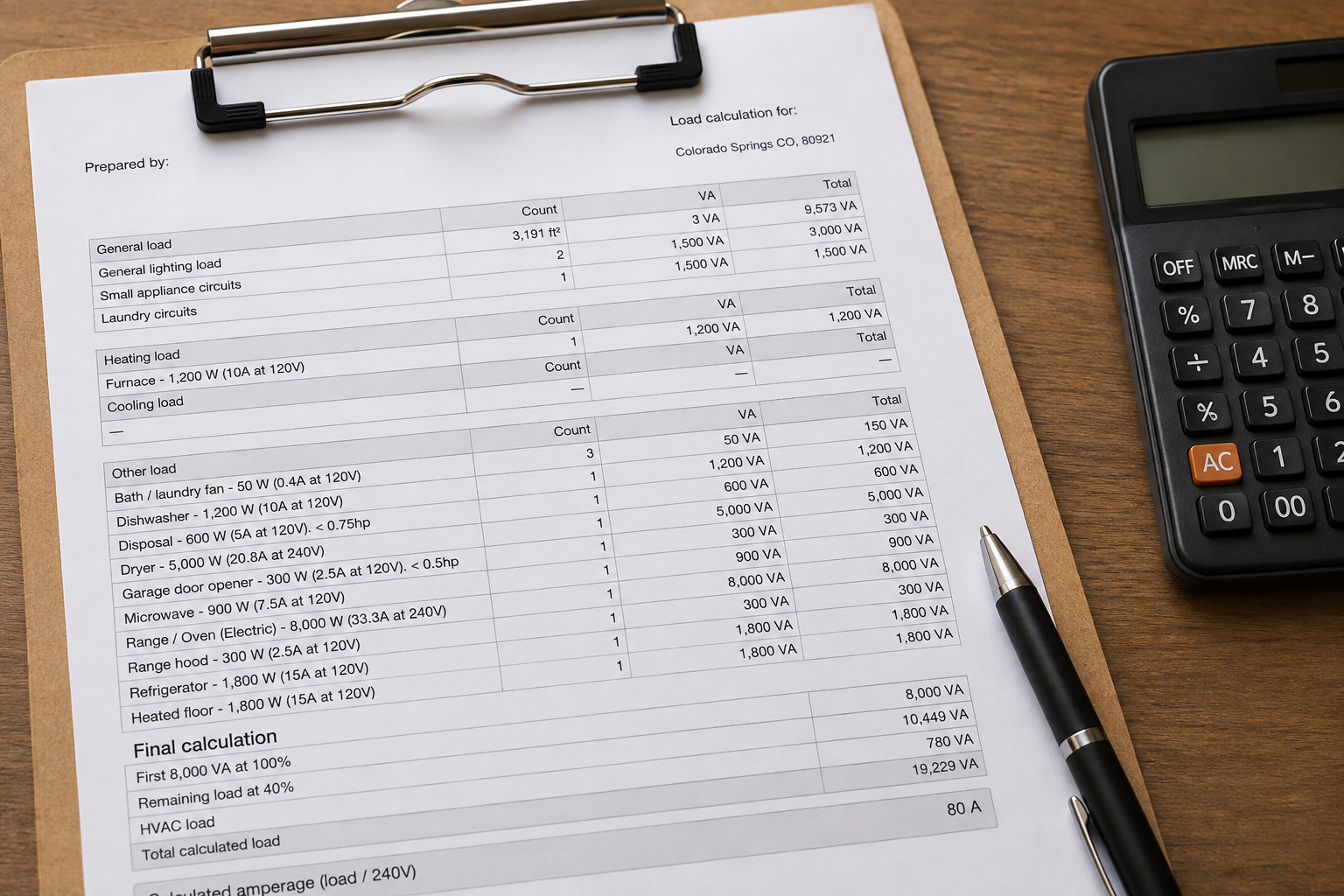
In general, the calculation considers the size of the home along with the electrical equipment it serves. That can include everyday lighting and receptacles as well as larger loads such as the range, dryer, water heater, heating and cooling equipment, fixed appliances, hot tubs and EV charging.
There is an important piece that makes this different from simply adding everything together: your house isn’t expected to use every electrical device at full capacity at the exact same time.
The National Electrical Code accounts for that through specific calculation rules and demand factors. There are also different code-approved ways of performing residential load calculations, including standard and optional methods. The methods calculate certain loads differently and won’t necessarily produce identical results. Which method can be used depends on the home and the circumstances.
For the homeowner, the important part isn’t the formula. It’s what the calculation tells us: Can the existing electrical service support what you want to add?
Let’s Go Back to That EV Charger
Suppose we’re evaluating that 200-amp service for an EV charger. After gathering information about the home, we perform the electrical load calculation and determine that there’s enough available capacity.
Great. We can move forward with planning the charger installation.
But what if there isn’t enough capacity?
This is where a load calculation becomes especially useful, because the answer isn’t automatically, “You need to upgrade your electrical service.”
Depending on the situation, an energy management system (EMS) may allow us to install the EV charger without increasing the home’s electrical service. These systems monitor the home’s electrical demand and manage EV charging based on the capacity that’s available. When the house is using more electricity, the system can reduce or temporarily pause charging; when demand drops, charging can resume.
We’ve encountered this option increasingly often as homeowners add EV charging to homes that weren’t originally designed with that additional electrical load in mind. Instead of assuming a larger electrical service is the only solution, the load calculation gives us the information we need to determine what options make sense.
What If My Electrical Panel Is Already Full?
This is another situation where capacity and physical space can easily get confused.
If every breaker space in your panel is occupied, that doesn’t necessarily mean you need a larger electrical service. Your home may have sufficient electrical capacity but simply not have enough physical room in the existing panel for the new circuits you want to add.
In some situations, adding a subpanel can provide the additional breaker space that’s needed while continuing to use the existing electrical service.
On the other hand, a panel can have several empty breaker spaces and the home can still be approaching the capacity of its electrical service. That’s why counting empty spaces doesn’t answer the same question as performing an electrical load calculation.
Load Calculations Aren’t Just for EV Chargers
EV chargers are an easy example because they add a significant new electrical load, but they’re certainly not the only reason we perform these calculations. A homeowner might encounter the same conversation when adding a hot tub, converting gas appliances to electric, installing new HVAC equipment, building an addition, completing a major remodel, or adding other equipment that substantially changes the home’s electrical demand.
Sometimes several smaller changes over the years are what finally bring the question up. A home built decades ago may now have air conditioning, an electric range, a hot tub and other equipment that wasn’t there when the electrical service was originally installed. Then someone buys an EV and wants to add a charger.
That’s when looking at the home as a complete electrical system becomes important.
The Answer Isn’t Always “You Need a Bigger Panel”
This may be the most important thing for homeowners to understand about an electrical load calculation.
The purpose isn’t to justify selling you a larger electrical panel or service. It’s to figure out what your home actually needs before we start adding equipment.
The calculation may show that there’s plenty of available capacity and nothing additional is needed. It may show that an EMS is a practical solution for an EV charger. If the issue is breaker space rather than electrical capacity, a subpanel may be appropriate. And yes, there are situations where the home’s electrical service really does need to be upgraded to support what the homeowner wants to add.
The point is that we don’t want to guess.
A Little Planning Before We Add More Power
Most homeowners will never need to understand the formulas behind an electrical load calculation, just as you don’t need to know every step your electrician takes when troubleshooting a circuit. What matters is understanding why we’re asking the questions.
When we ask about your square footage, appliances, heating and cooling equipment, hot tub or other electrical loads, we’re gathering the information needed to look at your home as a complete system. That allows us to determine whether the electrical service you already have can support the project you’re planning—and, if it can’t, what options may be available.
If you’re considering an EV charger, hot tub, new electrical equipment or another project that will add significant demand to your home, Gaddie Electric can evaluate your electrical system and determine what will be needed before installation begins. Learn more about our residential electrical services or contact Gaddie Electric to discuss your project.
Frequently Asked Questions
What is an electrical load calculation?
An electrical load calculation is a code-based way of determining the amount of electrical demand a home is expected to place on its electrical service. It considers the home and its electrical equipment rather than simply looking at the size of the panel or adding up breaker ratings.
Why does my electrician need to know what appliances I have?
Large electrical appliances and equipment contribute to the home’s overall electrical demand. Knowing whether you have equipment such as an electric range, dryer, water heater, air conditioner, hot tub or EV charger helps the electrician perform the calculation accurately.
What are the standard and optional load calculation methods?
They are different methods permitted by the National Electrical Code for calculating electrical loads in qualifying residential applications. They apply loads and demand factors differently, so the results aren’t necessarily identical. Your electrician determines which method is appropriate for the situation.
Does a full electrical panel mean I need a panel upgrade?
Not necessarily. If the electrical service has sufficient capacity but the panel doesn’t have enough breaker spaces, a subpanel may be one possible solution. Your electrician needs to evaluate both the available electrical capacity and the physical panel space.
Can I install an EV charger if my home doesn’t have enough available capacity?
Possibly. In some installations, an energy management system can monitor the home’s electrical demand and manage EV charging so the charger operates within the available capacity. Whether an EMS is appropriate depends on the home’s electrical system and the charger being installed.