
An outlet suddenly stops working. A breaker keeps tripping for no obvious reason. Half the lights on a circuit go out, or something electrical works perfectly most of the time but occasionally doesn’t. You know something is wrong, but you don’t know where the problem is—or what it will take to fix it.
That’s exactly what electrical troubleshooting is designed to figure out. Unlike installing a new light fixture or adding a receptacle, troubleshooting starts with an unknown. We know the symptom you’re experiencing, but until an electrician begins testing the electrical system, we don’t necessarily know what’s causing it, where the problem is located, or what will be required to correct it. That’s also why one of the most common questions we receive—“Can you give me a quote to fix it?”—isn’t always as straightforward as it sounds.
Electrical Troubleshooting Starts With the Problem, Not the Answer
When an electrician arrives for an electrical troubleshooting appointment, one of the first things they’ll do is ask questions. When did the problem begin? Is it happening constantly or intermittently? Did anything change around the time it started? Does anything else in the house lose power at the same time? The answers provide clues that can help narrow down where to begin.
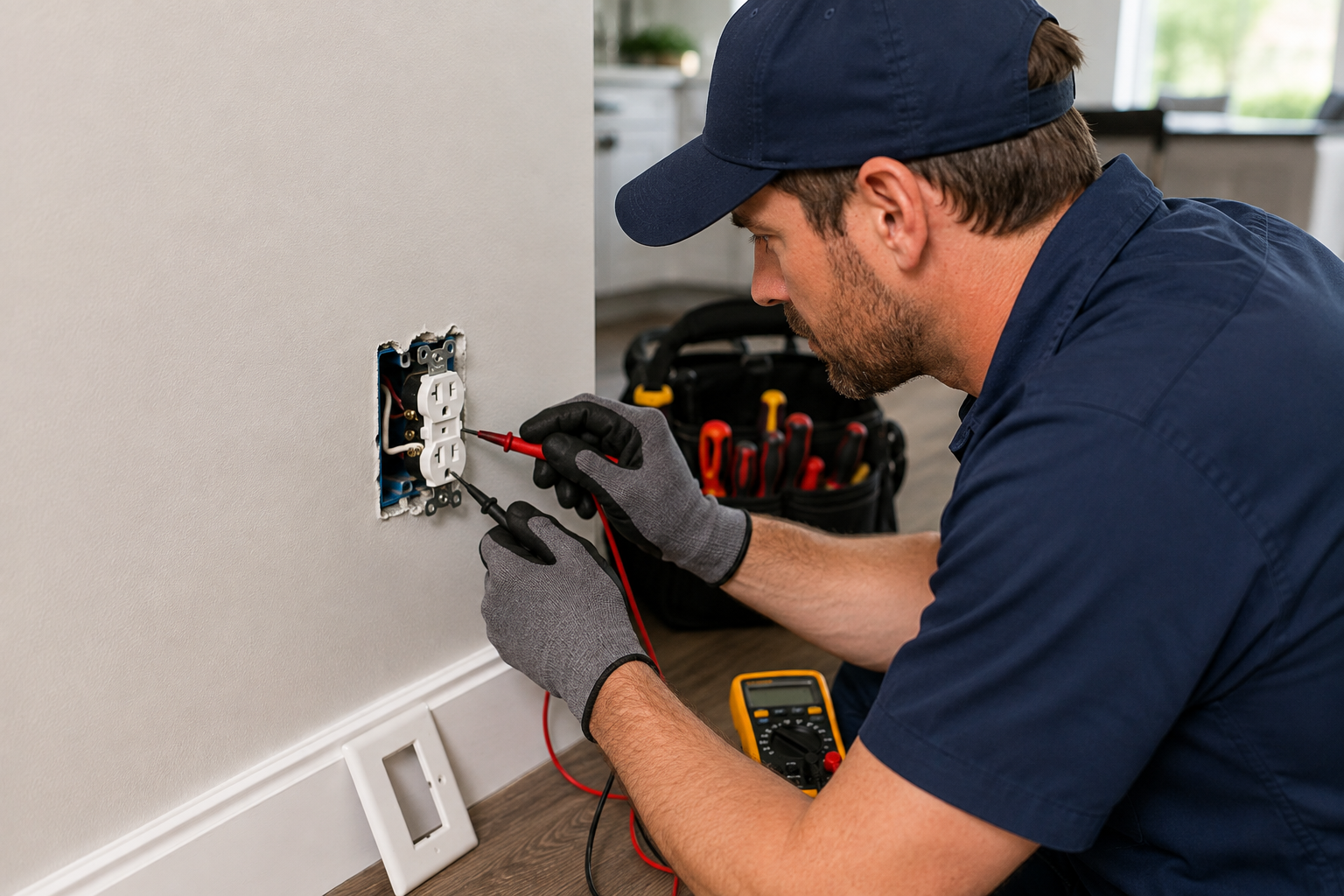
From there, the electrician starts testing. Depending on the problem, that may involve checking voltage, inspecting the electrical panel, testing breakers and GFCIs, removing receptacles or switches, inspecting connections, and determining what else is connected to the affected circuit. Each step provides information that helps eliminate possibilities until the actual source of the problem can be identified.
This is one reason electrical troubleshooting is sometimes compared to detective work. The electrician isn’t randomly taking things apart hoping to stumble across the answer. They’re following the information the electrical system is giving them and deciding what needs to be tested next.
The Problem May Not Be Where You Think It Is
If one outlet stops working, it’s perfectly reasonable to assume something is wrong with that outlet. Sometimes that’s exactly what the electrician finds, but electrical circuits don’t operate as a collection of completely independent devices. Several receptacles, lights, and switches may be connected to the same circuit, and a problem at one location can affect devices farther down the line.
A loose connection in one receptacle, for example, could cause another receptacle farther along the circuit to lose power. A tripped GFCI in one location might protect an outlet somewhere else. A breaker that appears to be the problem may actually be responding correctly to a fault elsewhere on the circuit. Until testing begins, there’s simply no reliable way to know.
That’s why replacing the device that appears to be malfunctioning isn’t always the answer. Good troubleshooting is about finding the cause of the problem rather than simply addressing the most obvious symptom.
Why Can’t an Electrician Just Give Me a Quote?
This is probably the biggest difference between troubleshooting and most other electrical projects.
If you ask us to install a new ceiling fan or add a dedicated circuit, we can evaluate what needs to be done and usually determine the scope of work before we begin. With electrical troubleshooting, determining the scope of work is part of the work. We often have to begin testing the system and taking devices apart before we can determine what’s wrong.
That makes stopping halfway through the process to prepare a traditional estimate impractical. Imagine an electrician removing devices, testing connections, tracing the circuit, and finally locating the problem—only to put everything back together, leave the home, have an estimator prepare a quote, wait for approval, and then schedule another appointment for an electrician to return and take everything apart again. In many cases, once we’ve spent the time identifying the problem, the actual repair is relatively straightforward.
For that reason, at Gaddie Electric, we handle most troubleshooting as a service call with a one-hour minimum rather than providing an estimate beforehand. The electrician can begin diagnosing the problem as soon as they arrive and, when possible, move directly into making the repair once the cause has been identified. It avoids duplicating work and is generally a much more practical way to handle an unknown electrical problem.
Why One Troubleshooting Appointment Takes 20 Minutes, and Another Takes Two Hours
Electrical problems don’t reveal themselves on a schedule. Sometimes an electrician removes a receptacle and immediately finds a failed connection. In another home, an outlet may intermittently lose power because of a loose connection somewhere else on the circuit, requiring the electrician to trace the circuit through several devices before finding it.
Intermittent problems can be especially challenging because everything may be working normally when the electrician arrives. Other problems involve wiring concealed behind finished walls or circuits that have been modified several times over the life of the home. Two homeowners can describe almost identical symptoms while the causes—and the time required to find them—are completely different.
That doesn’t necessarily mean a longer diagnosis is a more serious problem. It simply means there were more possibilities to eliminate before the electrician could confidently identify the cause.
What Are You Paying for During Electrical Troubleshooting?
When an experienced electrician finds a problem quickly, it can sometimes make the diagnosis look easy. What isn’t as visible are the years of training and experience that helped them know where to start, what to test, and how to interpret what they found.
A meter can tell an electrician that voltage isn’t what it should be, but the meter doesn’t tell them why. Knowing whether the next step should be checking the breaker, opening another receptacle, looking for a lost neutral, testing a GFCI, or investigating something entirely different comes from understanding how electrical systems work and recognizing patterns from problems they’ve encountered before.
In other words, you’re not paying someone simply to take outlets apart. You’re paying them to determine which things need to come apart in the first place, find the source of the problem safely, and figure out the appropriate repair.
From Diagnosis to Repair
The good news is that once the source of an electrical problem has been found, the repair is often much easier to determine. A failed receptacle can be replaced, a loose connection can be corrected, or another identifiable problem can often be repaired during the same appointment. If troubleshooting reveals a larger issue that requires additional materials, more extensive work, or a different approach, the electrician can explain what was found and discuss the next steps with you.
That is ultimately the goal of an electrical troubleshooting appointment. It’s not simply to make an outlet start working again or keep a breaker from tripping. It’s to understand why the problem occurred so the right repair can be made instead of guessing and replacing parts until something happens to work.
Electrical Troubleshooting in Colorado Springs
Electrical problems can range from remarkably simple to surprisingly difficult, and there’s usually no way to know which you’re dealing with until someone begins investigating. That’s why electrical troubleshooting is handled differently from projects where the scope of work can be determined ahead of time.
If something in your home isn’t working the way it should, Gaddie Electric provides electrical troubleshooting services throughout the Colorado Springs area. Our electricians can diagnose the problem, explain what they find, and, in many cases, complete the repair during the same service call. Are you currently having an electrical issue? Contact us today to schedule a service call at 719-268-9433.
Frequently Asked Questions
Can you give me a quote for electrical troubleshooting?
Usually not before troubleshooting begins. Because the cause of the problem is unknown, the electrician generally needs to test the circuit and may need to remove devices or inspect connections before determining what needs to be repaired. At Gaddie Electric, most troubleshooting is therefore handled as a service call with a one-hour minimum.
Can the electrician repair the problem during the troubleshooting appointment?
Often, yes. Once the problem has been identified, many repairs are relatively straightforward and can be completed during the same appointment. If the electrician discovers something requiring additional materials or more extensive work, they’ll explain what was found and what needs to happen next.
Why does electrical troubleshooting sometimes take a long time?
The symptom doesn’t always occur where the actual problem is located. An electrician may need to trace a circuit, inspect several devices, or eliminate multiple possible causes before finding the source. Intermittent electrical problems can take longer because the problem may not be occurring when the electrician is there.
What information should I give the electrician?
Tell the electrician when you first noticed the problem, how often it happens, what seems to trigger it, whether other devices are affected, and whether any electrical or remodeling work was recently completed. Even small details can provide useful clues.
Should I keep resetting a breaker that continues to trip?
A breaker that repeatedly trips is telling you something is causing it to operate. Rather than continually resetting it, it’s a good idea to have the cause investigated, particularly if the breaker trips repeatedly without an obvious explanation.