
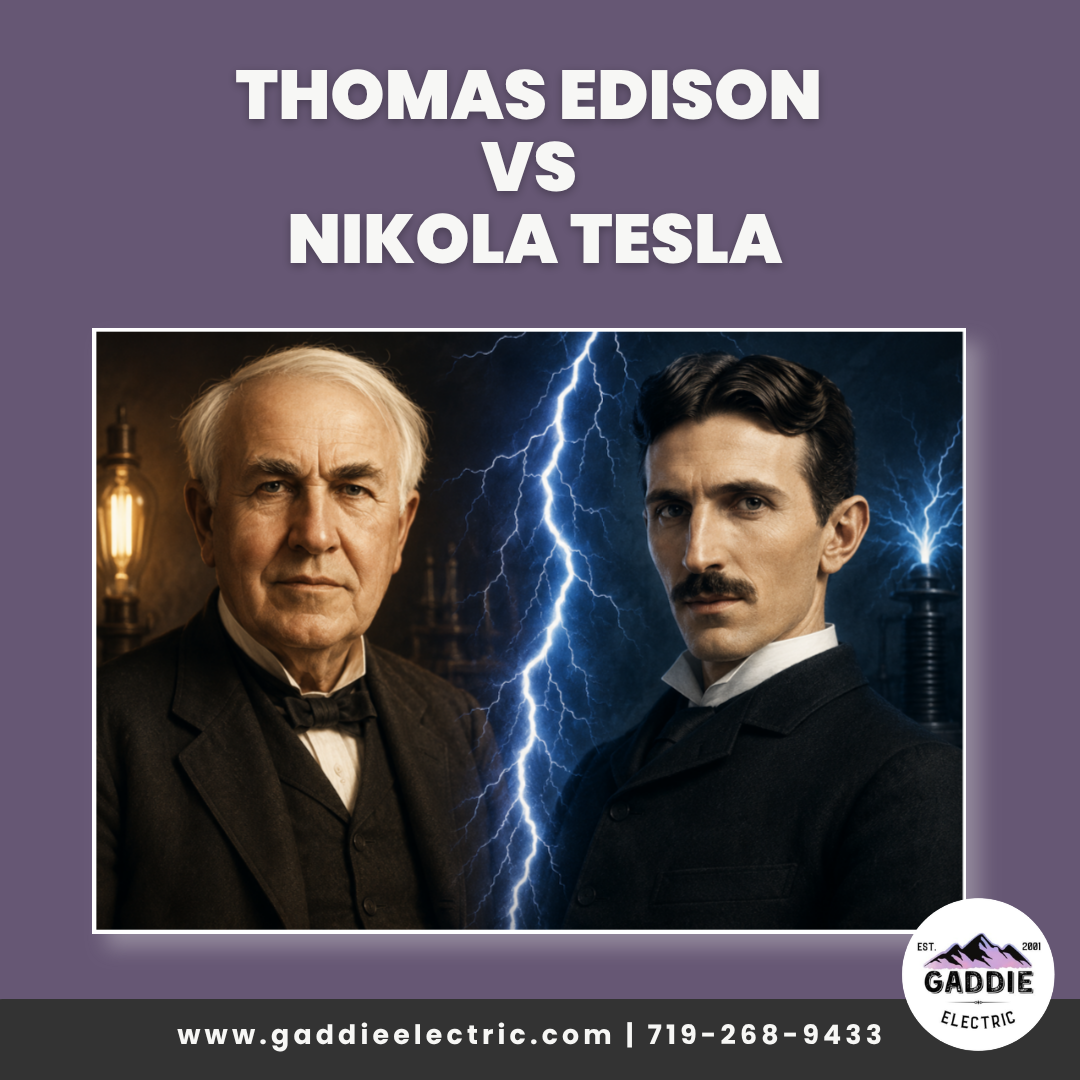
The Inventor Rivalry That Literally Changed the World
Long before celebrity feuds filled social media, the electrical industry already had its own legendary rivalry: Thomas Edison vs. Nikola Tesla.
And honestly? The story has everything. Genius inventors. Stolen credit. Billionaire backers. Public humiliation. Dangerous demonstrations. Wild rumors. Massive egos. And a fight over who would control the future of electricity itself.
This became known as the “War of the Currents,” and more than 100 years later, we are still living in the electrical world that came out of it.
It Started With a Job Offer Gone Wrong
Nikola Tesla originally worked for Thomas Edison after immigrating to the United States in the 1880s. At first, Tesla admired Edison and believed the famous inventor would support his ideas and innovations. That did not exactly happen.
According to Tesla, Edison promised him a huge bonus if Tesla could improve some of Edison’s struggling electrical systems. Tesla reportedly completed the work, but when he later asked about the payment, Edison allegedly laughed it off and told him:
“You don’t understand American humor.”
Tesla quit shortly afterward, which was not exactly the beginning of a healthy professional relationship.
The Real Fight: AC vs. DC
The rivalry quickly became much bigger than two inventors simply disliking each other. It turned into a battle over how electricity itself should work.
Edison promoted direct current (DC) electricity, while Tesla believed alternating current (AC) was the future. At the time, this was not just a scientific disagreement — it was a financial war worth millions of dollars. Whoever won would help shape the future electrical infrastructure of entire cities.
Today, the electricity powering homes throughout Colorado Springs still relies on the same AC system Tesla fought to promote.
Tesla Was Brilliant… and Extremely Weird
Tesla was undeniably brilliant, but he was also eccentric in ways that would probably make him internet-famous today. He reportedly visualized inventions entirely in his head, worked for days without sleeping, memorized entire books, and spoke multiple languages.
But he also developed some incredibly unusual habits and obsessions over time. Tesla became fixated on the number 3, extreme cleanliness, avoiding physical contact, elaborate eating rituals, and, perhaps most famously… pigeons. Some stories claim Tesla developed emotional attachments to pigeons later in life and spent much of his time feeding them in New York City parks.
Meanwhile, Edison was less of a mysterious genius and more of a relentless businessman. He aggressively protected his ideas, competed fiercely, and built entire teams of inventors working under him. In many ways, Edison was the ultimate industrial entrepreneur, while Tesla became the classic misunderstood inventor.
Learn more about Nikola Tesla’s life and inventions.
Edison Basically Started a Fear Campaign
This is where the story gets especially wild. Tesla’s AC power system was incredibly effective, and Edison quickly realized it threatened everything he had built around his DC electrical systems. If alternating current became the standard, Edison’s own electrical infrastructure could become obsolete.
Instead of quietly accepting defeat, Edison launched a very public campaign intended to convince people that AC power was dangerous, and honestly, some of the demonstrations became pretty disturbing. At the time, most people barely understood electricity at all, which made fear an incredibly effective marketing tool. Edison began publicly demonstrating the dangers of alternating current by electrocuting animals in front of audiences in an attempt to portray AC electricity as unsafe.
The campaign escalated over time and became one of the strangest public relations battles in technological history. Edison’s team even pushed for AC electricity to be used in the first electric chair because they wanted the public to associate Tesla’s system with death. Imagine being so competitive that you help create an execution method simply to damage your rival’s reputation. The “War of the Currents” stopped being just a scientific disagreement and started looking more like industrial-era reality television.
Tesla Still Won
Despite Edison’s efforts, AC power had one massive advantage: it simply worked better for powering large areas.
Alternating current could travel much farther distances efficiently, which meant entire cities could finally receive electricity without requiring power stations every few blocks. One of Tesla’s biggest victories came when AC power was selected for the 1893 Chicago World’s Fair. The event lit up thousands of lights and stunned visitors from around the world.
Not long afterward, Tesla and Westinghouse helped develop the Niagara Falls hydroelectric project, proving AC could power cities on a massive scale. At that point, the battle was basically over. AC became the standard electrical system used throughout most of the world — including the electricity powering homes throughout Colorado Springs today.
So… Was Tesla the Hero and Edison the Villain?
The internet loves turning Edison into the villain and Tesla into the forgotten hero, but reality is usually more complicated than that.
Edison absolutely made major contributions to modern electrical systems and helped make electricity practical for everyday use. Tesla truly was revolutionary and far ahead of his time in many ways. But both men were also competitive, stubborn, ambitious, and deeply determined to win. That may actually be part of why this story still fascinates people more than a century later.
Learn more about Thomas Edison’s life and inventions.
Your House Actually Uses Both Systems Today
Here’s the funny part: modern homes actually use both AC and DC power today.
Your home receives alternating current (AC) power from the utility company — the same system Tesla fought so hard to promote. But many electronics inside your home convert that power into direct current (DC) internally.
Things like cell phones, laptops, LED lighting, televisions, and battery-powered devices all rely on DC power in some form. That little charging block plugged into your outlet is often converting AC electricity into DC power for your electronics.
Modern homes have changed dramatically since Edison and Tesla’s time, especially as homeowners add EV chargers, smart technology, and larger electrical loads.
Can Your Electrical Panel Handle an EV Charger?
Why People Still Love This Story
The Edison vs. Tesla rivalry continues to fascinate people because it was never really just about electricity.
It was about ego, innovation, money, public image, ambition, and the future of technology itself. And honestly, some parts of the story still sound completely unbelievable today.
A mysterious inventor obsessed with pigeons battling a ruthless businessman in a fight over the future of electricity?
Hollywood could not write it much better.
Final Thoughts
More than a century later, the battle between Edison and Tesla remains one of the strangest and most entertaining rivalries in technological history. And while parts of the story sound almost unbelievable today, the outcome shaped the modern electrical world we still rely on every single day.
At Gaddie Electric, we love the history behind the electrical industry and the innovations that continue to shape modern homes throughout Colorado Springs and the surrounding areas. Because honestly? Electrical history is way more interesting than most people realize.
Frequently Asked Questions
Did Tesla really work for Edison?
Yes. Tesla briefly worked for Edison before the two became rivals.
Did Edison and Tesla hate each other?
They strongly disagreed professionally, and the rivalry became increasingly personal over time.
Did Edison really electrocute animals?
Yes. Public electrocution demonstrations were used during the “War of the Currents” to portray AC electricity as dangerous.
Why did AC power win?
AC power could travel much longer distances efficiently, making it far better for powering cities and electrical grids.
Do homes still use Tesla’s AC system today?
Yes. Modern homes throughout the United States still use alternating current (AC) electrical systems.
Do modern homes use DC power too?
Yes. Many electronics and battery-powered devices still use DC power internally, even though homes receive AC power from the utility company.